Tuesday, June 8, 2010
Exhibition June11th - 20th Carlow Ireland Seven Oaks Hotel
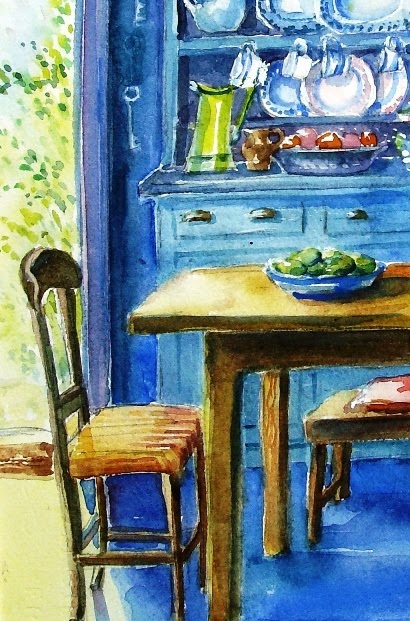
Photos of some new work in Watercolours Oils and Acrylics for my Summer exhibition in the fringe Eigse Festival Carlow




Saturday, May 29, 2010
TURNER'S ART - 200 years old - still daring

JMW TURNER 1775 – 1851
The greatness of Turner was a reckless appreciation of natural wildness; -the glory of natural light produced by the sun with casual ease morning after morning, the many natural variations of light and atmosphere produced by climatic variations - Like the Irish weather the English climate cannot be relied upon -these elusive and inconsistent qualities elicited from Turner new improvisatory painting techniques.
Watercolour played a significant role in his artistic development and later became his means of private expression and experiment. He invented numerous devices ; colour piment was laid on wet paper; near finished work was scrubbed out or soaked in baths of water to diffuse paint, he scratched away the surface of the paper and manouvred wet watercolour with his fingertips.His repertoire of watercolour effects became phenomenal. He created a new artistic language.
Turner’s daring disregard for realism was unprecedented and was not matched again until the 20th century with the Abstract Expressionists Pollock, Rothko and De Kooning.
"Turner disturbed those who met him by conforming little to the accepted idea of a great artist - A cockney – not over scrupulous about cleanliness or correct pronunciation was passionately intent on the things that mattered to him.
He was recognised as great from the beginning –his innovative pourings and soakings of paint bore the stamp of genius."
Thursday, May 27, 2010

ALL NEW -ART SAMPLE DAY with Trudi Doyle
1 day €55
A chance to try Drawing & some Watercolours & Acrylics. Suitable for those who have always wanted to take up painting but haven’t got round to it.
This day will introduce you to basic drawing & painting techniques & skills on how to compose a painting and give you a taste of painting with watercolours & acrylics. All materials are supplied for the day and you will go home with a new insight and hopefully enough enthusiasm to continue painting.
You may bring your own materials if you prefer.
Materials supplied.
MAY - Sunday 30th 5 places
DRAWING DAYS tutor Trudi Doyle €55
Although ideal for someone taking their first steps in art , this basic drawing day will be enjoyed by painters who might have bypassed drawing and want to improve their draftmanship . Learn essential drawing techniques which will provide a solid foundation to build on & will develop good observational skills to enhance painting.
MAY - Saturday 29th
JULY- Saturday 24th
Friday, April 9, 2010
The hare in the folk myths of our ancestors.


One of the largest fertility festivals of the ancient calendar, Eostra, falls on the spring equinox when day and night are in equal balance and life has returned in profusion.The Anglo-Saxon Goddess of sunrise and spring was known as Eostra or Eastre and her sacred month was called 'Eastremonath' - Moon of Eostre.
Like all the Christian church's moveable feasts, Easter shows it's pagan origin in a dating system based on the old lunar calendar.It is always the first Sunday after the first full moon after the Spring Equinox.The Christian festival wasn't called Easter until the Goddess's name was given to it in the late Middle Ages.
The Irish observed Easter on a different date from that of the Roman church, probably the original date of the festival of Eostre, until the Roman calendar was imposed in 632 A.D.
The most striking thing about the mythology of hares is the degree of commonality across the globe, there are long-spoken tales of hares from the Americas to the Far East, from Africa to Europe. The hare is embedded in the folk myths of our ancestors. It is associated in mythology with the Moon, the celestial skies and the Sun, with fertility, the dawn, cunning and bravery. There is evidence of hare mythology in ancient pottery, coins, seals, and hieroglyphics and in oral history. (In Egypt the hare symbolised the very essence of life itself: the hieroglyphic 'Wn', depicting a hare on top of a single blue-green ripple, means 'to exist'). Similar to the fact that most ancient cultures have a flood myth, most also seem to have hare mythology. What was it about the hare which led to this mythology? We will probably never know for sure, but the fact that wild hares lived in proximity to people, perform unique and uninhibited courtship dances, are extremely sexually active in the spring and are active at night, were all factors.
Friday, April 2, 2010
Further musings of a watercolourist


Even after many years of practice there is always an element of excitement and surprise for me when painting in watercolour. Unlike other painting techniques (oil painting , acrylic, chalk pastels and oil pastels etc.) in which the materials have an inertia of their own, watercolour painting is based on an elusive and moving substance which posesses its own metamorphic energy ( water).
An essential requirement for a watercolourist is patience -it has taken many years of working in watercolour to develop a working method that allows sufficient time for various techniques to produce the effects required .
Sunday, March 7, 2010
No pool of water is like any other - Musings of a watercolourist

Watercolour paintings are not usually prey to forgers –the very difficulties of managing water, of imitating the instantaneous marks produced by the action of the artist in combination with pools of pigmented water ensures that each work is unique and almost impossible to recreate.
Painting wet in wet requires a calm mind, spontaneous movements & focus - when I am painting in the flow I lose track of time; I am in the moment yet out of concious time - a seeming contradiction.

Gaining an understanding of watercolour takes patience and practice and many pools of colourful water both on & off the paper.
Thursday, February 25, 2010
TUSCAN Art holiday


FLY TO PISA and I will organise the rest - Hotel - airport transfers, food, wine, painting excursions visits to Florence and the Uffitzi Gallery and much more - Italy will charm you!


Photos of the area in Italy where I am holding my art holiday in Montecatini , Tuscany from Wednesday 18th August to Weds 25th.2010.
Subscribe to:
Posts (Atom)